
Sonoma, CA · Garage Door Service
Why a Door Goes Off Track in Sonoma
Sonoma's 1960s-70s housing stock and mild, occasional-freeze climate push garage door tracks out of alignment in specific, predictable ways. Here's why.
- Repairs & new doors
- Springs & openers
- Serving 6 nearby communities
How Local Conditions Play In
Most of the houses we work on here went up between 1947 and 1988, with the bulk of the stock dating to the 1960s and 70s. That matters for tracks because those garages were framed with the hardware of their era - steel tracks mounted on wood jambs that have had fifty-plus years to shift, settle, and dry out. A track that was plumb in 1969 is rarely plumb now, and the door riding on it has been compensating a little more every year.
Sonoma's climate sits in a mild band with occasional freeze nights, not the hard freeze-thaw cycles that crack concrete slabs further inland or at elevation. That's a point in your favor - we don't see the frost-heave track separation that shows up in colder regions. But mild doesn't mean static. Temperature swings between warm days and cool nights still make wood jambs expand and contract, and track brackets bolted into that movement loosen over decades rather than all at once. On original hardware from the 1960s and 70s, that slow loosening is the single biggest reason a door starts to bind or walk off the track.
What Most People Get Wrong
The common assumption is that a door off its track got knocked out of place by something - a car bumper, a slammed door, a storm. Sometimes that's true. But on houses from this area's typical build years, we more often find the opposite: nothing hit it. The track simply worked loose from a jamb that's been seasoning and settling since the Johnson administration.
People also assume realigning the track fixes it for good. On original 1960s-70s brackets, realignment is often a temporary patch - the screw holes in fifty-year-old wood have enlarged, and a track that's been reset once tends to walk again within a year or two because the fastening point itself is worn out, not just the alignment. We'll tell you straight when a track needs new mounting points versus a simple adjustment, and sometimes the honest answer is that patching an old bracket isn't worth it if the rest of the hardware is original too.
The Problem
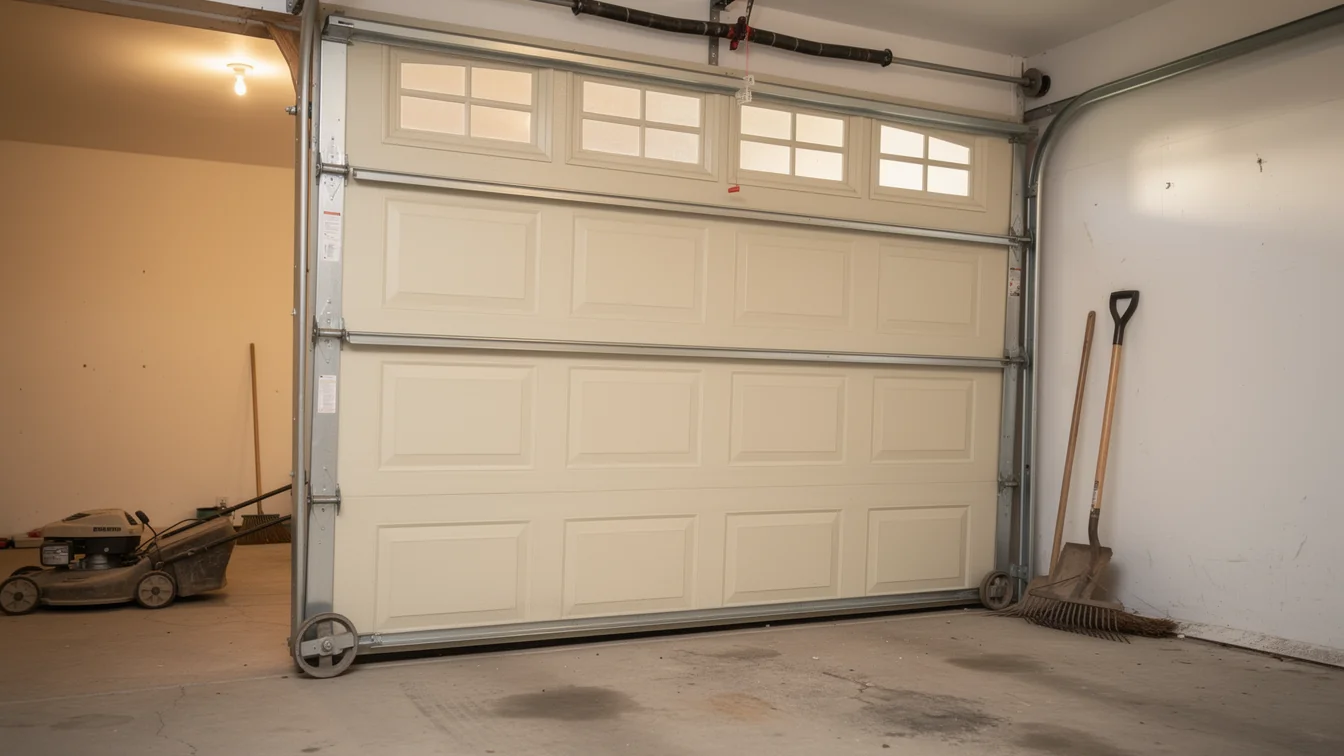
A door that's off track almost never announces itself cleanly. It starts as a rumble, a slight hesitation an inch or two into the travel, or a gap between the roller and track you'd only notice looking for it. On the housing stock common here - built mostly in the 1960s and 70s - that early hesitation is usually a bracket that's loosened from decades of minor wood movement rather than a single event.
Left alone, it gets worse fast. Rollers riding a slightly bent or separated track wear unevenly, which puts more side-load on the opener and the cables. On a two-car door, an off-track condition on one side can bind the whole panel and strain the opposite cable until it frays. We've opened enough of these original-era garages to know the pattern: small misalignment, ignored for a season, turns into a roller that's jumped the track entirely and a door that won't move at all.
Season by Season
Sonoma doesn't put a door through the brutal cycles some regions do - the climate here is mild with only occasional freeze nights - so you won't see the dramatic cold-snap failures that crack hardware overnight. What you get instead is slower and easier to miss. Warm, dry summer days followed by cool nights keep wood jambs working through small expansion and contraction cycles year-round, and on homes with original or near-original hardware from the 1947-1988 build era, that steady movement is what loosens track brackets over time rather than any single season doing the damage.
The practical upshot: there isn't one month we'd tell you to watch for off-track doors here the way we might for towns with hard winters. Instead, it's worth a visual check at the start of each season - does the door still sit flush against the track, do the rollers look even on both sides. Catching the early wobble before a freeze night and a warm afternoon both lean on a loose bracket is cheaper than catching it after.
Frequently asked questions
Why does my garage door keep coming off the track even after it's been fixed?
On houses built in the 1960s and 70s - the bulk of this area's stock - the wood jamb the track is bolted to has had decades to season and shift. Realigning the track doesn't replace worn screw holes, so it can walk again. If your house is from that era, ask us to check the mounting points, not just the alignment.
Is Sonoma's climate hard on garage door tracks?
Not in the way cold-climate towns experience it. We're in a mild band with only occasional freeze, so we don't see frost-heave separating slabs or hardware. The wear here comes from decades of minor wood movement in older jambs, not extreme weather swings.
How do I know if my garage was built with original track hardware?
If your house dates to the 1947-1988 range common in this area, especially the 1960s-70s peak, there's a real chance the track brackets are original. Signs include visibly enlarged screw holes, uneven wear on the mounting rail, or a track that's been shimmed before.
Is it worth repairing an old track or should I replace it?
Depends on the bracket and jamb condition. If the wood around the mounting points has enlarged holes from decades of use, a patch rarely holds. We'll look at the specific hardware before recommending either - sometimes a tightened and re-shimmed bracket is genuinely fine.
Related garage door services in Sonoma
More garage door guides
Book garage door service in Sonoma
Call now or request a quote - tell us what the door is doing and where you are.