Sonoma, CA · Garage Door Service
Fixing Versus Replacing an Original Sonoma Garage Door Pros
Most Sonoma homes date to the 1960s and 70s, so a sagging original door often just needs new hardware and springs, not a full replacement. Here's how to tell.
- Repairs & new doors
- Springs & openers
- Serving 6 nearby communities
How Local Conditions Play In
Most houses in this service area were built between 1947 and 1988, with the median landing around 1969. That puts a lot of garages on original steel sectional doors hung on first-generation torsion hardware, not the rolled-steel insulated panels that came later. Across the 18 named areas that make up this territory, the bulk of the stock is 1960s and 70s construction, which means the springs, drums, and cable drums on a lot of these doors have never been swapped.
The climate here is mild with only occasional freeze, so you're not fighting ice-jammed tracks the way a colder town would. What you're fighting instead is slow decay: sun-dried seals, UV-brittle plastic rollers, and wood trim that's taken fifty-plus years of expansion and contraction. A door from 1969 that still runs smooth isn't lucky, it's been maintained, and that's the first thing worth checking before anyone talks about replacement. The hardware era matters more than the door's looks. A torsion spring rated for a 1969 door is a known quantity; the question is whether it's original or already been swapped once.
What Most People Get Wrong
The common mistake is assuming an old door automatically means a bad door. With 11,737 owner-occupied houses out of 20,065 households in this area, we see plenty of original garages where the panel is fine and the actual failure is a tired spring, a stretched cable, or rollers that have gone stiff with age. People call wanting a full replacement when the fix is an hour of hardware work.
The opposite mistake happens too. Someone patches a cracked panel or re-tensions a spring on a door that's past it, and six months later they're back to square one because the real problem was the track alignment or a warped section, not the part they just replaced. At a median household income of $120,523, most owners here could afford to replace a door outright, but that's a decision about the door's actual condition, not a default. The honest answer is you have to look at the panel, the track, and the hardware separately before deciding which one, if any, needs to go.
The Problem
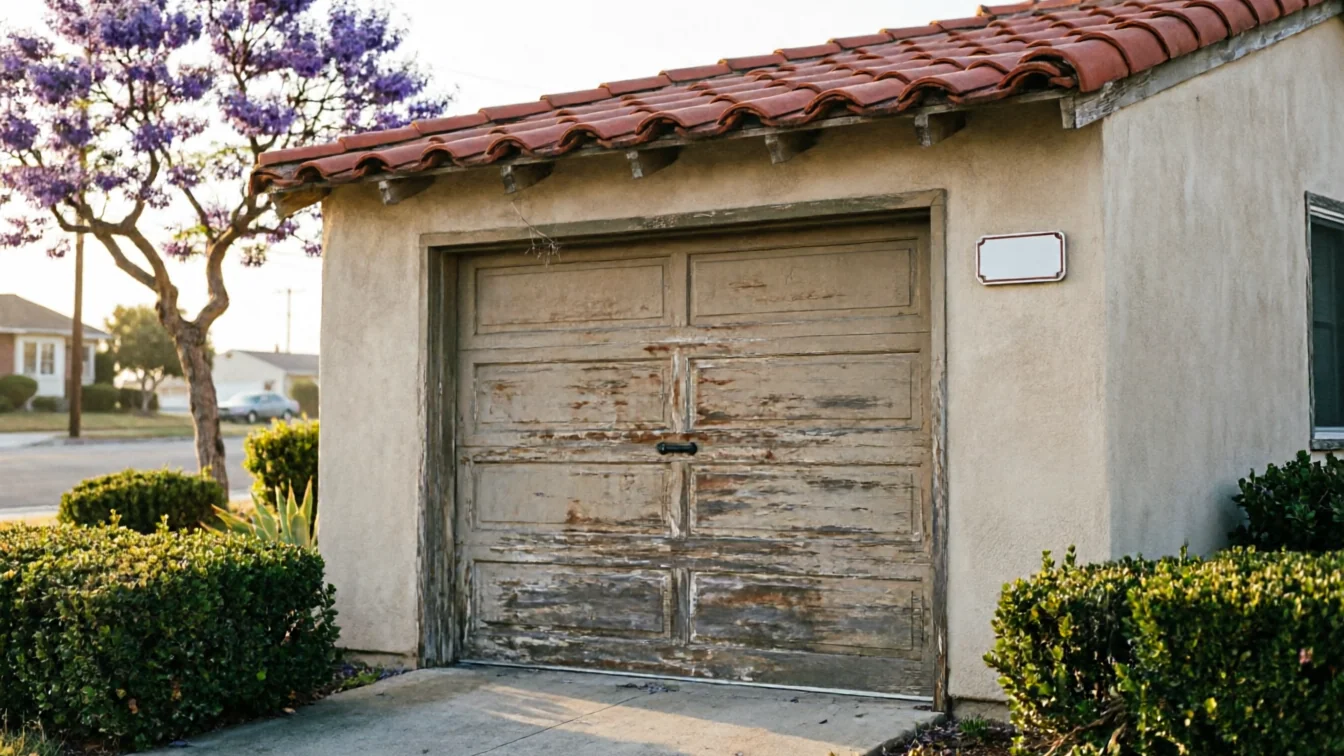
On a door built in the 1960s or 70s, the panel itself is usually the long pole. Steel sectional doors from that era weren't galvanized the way modern ones are, so once rust starts at a bottom panel seam or a dented corner, it spreads under the paint where you can't see it until the metal's already thin. Wood-panel garage doors from the same period have the opposite failure mode: dry rot at the bottom rail from decades of ground moisture wicking up, even in a mild climate.
Track and hardware problems are a separate issue and usually cheaper to fix. A torsion spring on a door this old has likely already outlived one duty cycle and is due, or overdue, for replacement regardless of how the panel looks. Here's the limitation worth saying out loud: once rust or rot has gone through the panel itself, we don't recommend patching it. At that point a new door costs less over time than repeated panel repairs, and we'll tell a homeowner that directly instead of billing for a fix that won't hold.
Season by Season
Because the climate band here is mild with only occasional freeze, the seasonal stress on an old door is gradual rather than dramatic. Summer heat dries out weatherstripping and any wood trim faster than people expect, so a door that sealed fine in spring can show daylight gaps by late summer. That's worth catching before it becomes a rot entry point on a wood-panel door from the 1960s stock that's common here.
The occasional cold snap is the other stress point. It won't freeze a track solid the way a harder winter climate would, but a brief cold stretch after a long dry spell can make old grease in the rollers and hinges seize up just long enough to strain a spring that's already near the end of its life. On a door with original 1960s or 70s hardware, that's often the moment a weak spring finally lets go. Spring and fall are the better windows to get hardware checked, before either seasonal swing finds the weak point for you.
Frequently asked questions
My garage door is from the 1960s. Is it worth fixing or should I replace it?
Depends on what's actually wrong. If the panel is solid and it's a spring, cable, or roller issue, fixing original hardware on a 1960s or 70s door is usually the cheaper and sensible call. If rust or rot has gone through the panel steel or wood, repair won't hold long term and replacement makes more sense.
Does Sonoma's climate wear out garage doors faster?
Not from freeze damage, since the climate here only sees occasional freeze. The bigger factor is sun and dry heat cycling the weatherstripping, wood trim, and plastic rollers over decades. On an original door from the 1960s or 70s stock common in this area, that slow drying is usually what fails first.
How do I know if my original hardware has already been replaced?
Look for mismatched spring color or a drum that looks newer than the rest of the track. On a door built when the median local house went up, around 1969, original torsion hardware has typically been through at least one full spring replacement cycle by now, so a shiny spring on an old door usually means someone's already swapped it.
Related garage door services in Sonoma
More garage door guides
Book garage door service in Sonoma
Call now or request a quote - tell us what the door is doing and where you are.