Sonoma, CA · Garage Door Service
Emergency Garage Door Repair, Lucas Valley-Marinwood
Emergency garage door repair for Lucas Valley-Marinwood homes built around 1963, covered by the Sonoma crew 18 miles out. Original hardware, mild-climate wear, and what the fix involves.
- Repairs & new doors
- Springs & openers
- Serving 6 nearby communities
What You Are Seeing
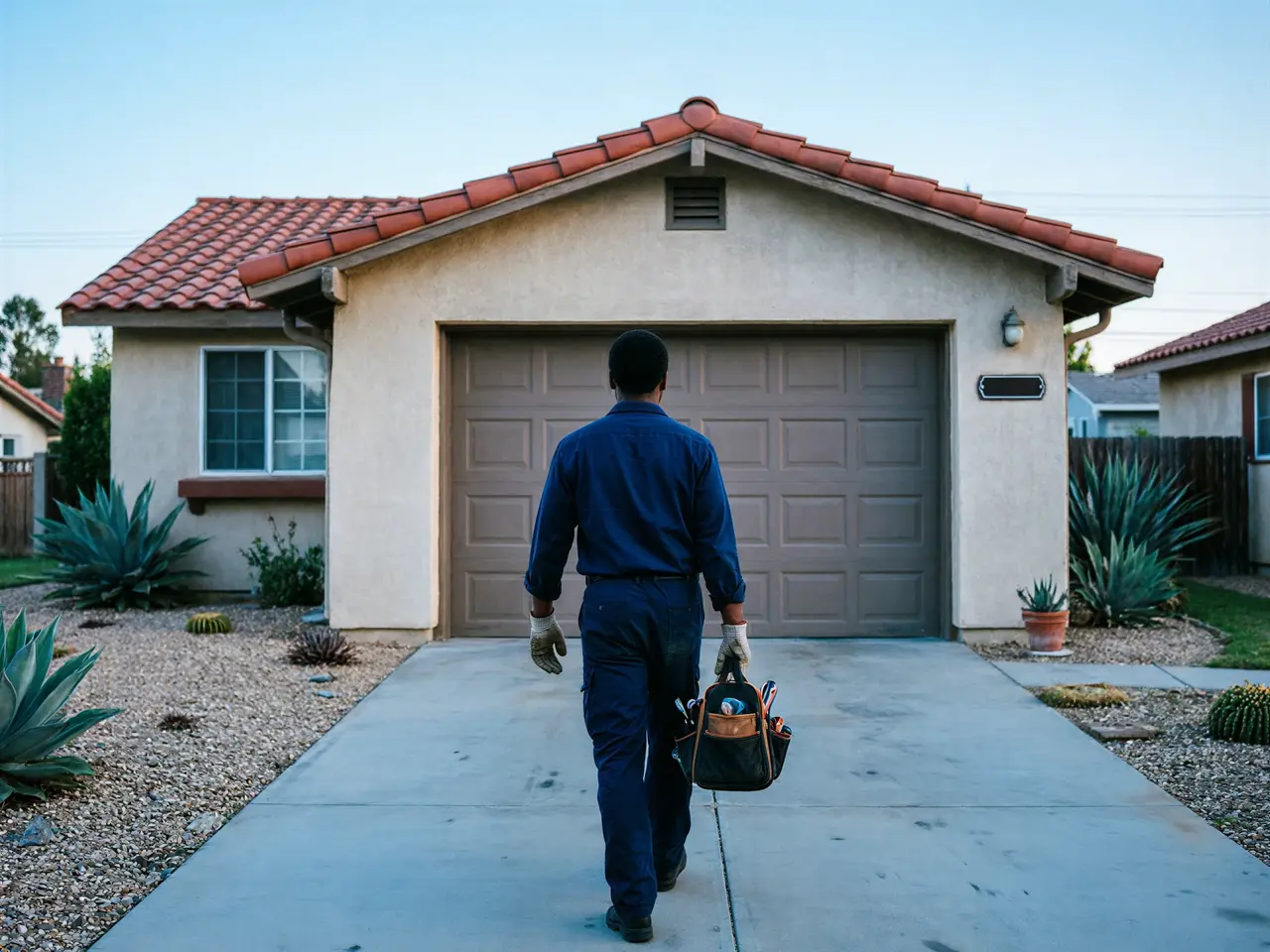
If your house in Lucas Valley-Marinwood went up anywhere near the neighborhood's median build year of 1963, there's a decent chance the torsion spring, the track brackets, or even the original rollers on that garage door have never been swapped out. Nobody replaces hardware that isn't broken, so a lot of it just sits there aging for six decades until the day it doesn't hold anymore. That's usually what an "emergency" call here actually is: not a sudden defect, but original-build hardware finally giving out, often all at once, because spring, cable, and roller wear tend to compound together on a door that's never been serviced.
What you'll notice first is usually one of three things: the door won't move at all and the opener strains or clicks without lifting, the door is stuck halfway on one side with a cable hanging loose, or a spring has snapped with a bang you heard from inside the house. Any of those means stop using the opener - a door with a broken spring is lifted by the opener motor instead of the spring, which strains the motor and can let the door drop. Don't force it by hand either if one side is jammed; that's how an off-track panel gets bent.
How Long It Takes
We're honest about this: we're coming from Sonoma, 18 miles out, so there's drive time built into any call here - this isn't a neighborhood with its own depot or crew standing by. That doesn't mean it's slow, but it does mean we're not pretending to be five minutes away. Once a tech is on site, most emergency fixes - a broken torsion spring, a snapped cable, a jammed roller - are a same-visit repair, usually an hour or two of work depending on what's actually failed and whether the opener needs attention too.
Where it stretches out is parts. A door from the 1963-era build wave sometimes uses spring sizing or track hardware that isn't a common stock item anymore, and if that's the case, the first visit is diagnosis and a temporary stabilize rather than a full fix. We'd rather tell you that up front than promise a one-trip job and miss it.
What Causes It Around Here
Lucas Valley-Marinwood sits in a mild climate with occasional freeze risk, which is gentler on garage door hardware than a lot of the country gets, but it's not nothing. Temperature swings between a cold overnight and a warm afternoon make steel springs expand and contract, and over enough years that cycling is exactly what fatigues a torsion spring that's never been replaced since a 1963-era install. It's not dramatic weather damage - it's decades of small stress on hardware nobody thought to touch.
The other factor is just household size and door-cycle count. With roughly 2,421 households in this pocket, most of them presumably running one garage door opener daily for years, the math on spring-cycle life catches up eventually regardless of weather. We see failures cluster on original hardware simply because original hardware is what's still there to fail.
What the Fix Involves
For a broken torsion spring, the job is matching the spring's wire size, length, and wind direction to the door's weight and drum setup - on an original 1963-era door that often means measuring from scratch rather than pulling a label, since labels wear off or were never standard. For a snapped cable or a jumped track, it's inspecting both sides, since a cable failure under load usually stresses the opposite side's hardware too, even if it looks fine.
One limitation worth saying plainly: if the door itself is original from that build era - steel skin, no insulation, worn seals - and the opener's also original, sometimes the honest call is that a full repair costs most of what a new door costs. We'll tell you that instead of patching something that'll fail again in a year. For straightforward spring, cable, or roller repair though, that's a direct, same-visit fix.
Frequently asked questions
Is the garage door spring in my house original?
If your home in Lucas Valley-Marinwood was built around the neighborhood's 1963 median, and the spring has never been serviced, it's likely original or close to it. Torsion springs are rated for cycles, not years, but a 60-year-old spring that's never failed before is usually close to the end of its life regardless of how it looks.
Why is there no local branch covering Lucas Valley-Marinwood?
We run out of Sonoma and cover this area as part of the wider service region, about 18 miles out. There's no separate depot here, so every call includes drive time - we won't claim a response time we can't back up from that distance.
Can a broken spring damage anything else?
Yes. Once a spring snaps, the garage door opener is left lifting the full weight of the door alone, which strains the motor and gears. If you keep running the opener after a spring breaks, you risk turning a spring repair into a spring-and-opener repair.
Do you stock parts for older 1960s doors?
Sometimes the spring size or track hardware from a 1963-era install isn't a common stock item. When that happens, the first visit is usually diagnosis and a temporary stabilize, with the full repair scheduled once the right parts are confirmed.
More garage door services in Lucas Valley Marinwood
- Garage Door Repair in Lucas Valley Marinwood
- Garage Door Service in Lucas Valley Marinwood
- New Garage Door Installation in Lucas Valley Marinwood
- Off-Track Garage Door Repair in Lucas Valley Marinwood
- Garage Door Opener Installation in Lucas Valley Marinwood
- Garage Door Opener Repair in Lucas Valley Marinwood
- Garage Door Roller Replacement in Lucas Valley Marinwood
Book garage door service in Sonoma
Call now or request a quote - tell us what the door is doing and where you are.