Sonoma, CA · Garage Door Service
Garage Door Service for Eldridge Homes
Garage door repair and service for Eldridge, CA homes built around 1969. We cover Eldridge from our Sonoma shop, 4 miles out, and know the hardware this era used.
- Repairs & new doors
- Springs & openers
- Serving 6 nearby communities
What Causes It Around Here
Eldridge sits about 4 miles from our shop in Sonoma, and the houses out here mostly went up around 1969, the same era as a lot of the broader service area's stock. That matters more than the mileage does. A door installed when the median home here was built is a door that's outlived its original springs, its original rollers, and in a lot of cases its original opener.
What we actually find on these calls is pretty consistent: galvanized extension springs that were sized for a lighter door than the one now hanging on them, steel tracks that have loosened at the brackets over five decades of use, and openers with no modern safety reversal because they predate the 1993 federal requirement for it. None of that is unique to one house - it's what you get when a neighborhood's garage doors are all roughly the same age. The mild climate here, with only occasional freeze risk, means the metal isn't fighting big temperature swings, so corrosion and fatigue show up slower than in harsher climates - but fifty-plus years still gets there.
What the Fix Involves
Most Eldridge calls start with us confirming whether the spring system is original or was already swapped once - a lot of 1969-era doors have had one spring replacement by now, and the second one needs matching, not guessing. If it's a torsion setup, we measure the drum, wire gauge, and wind to get the new spring balanced to the door's actual weight, not a generic size.
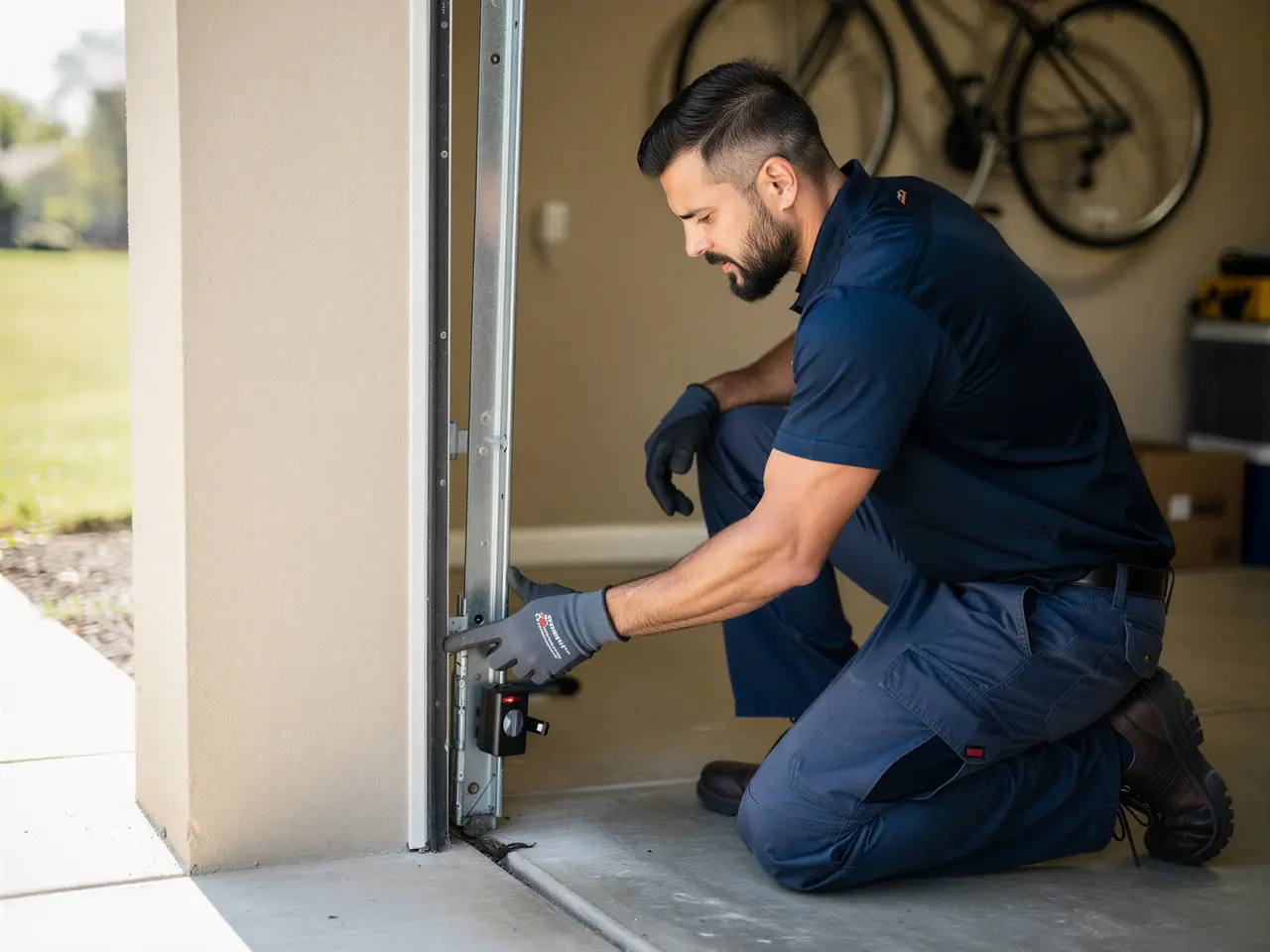
Track and hinge wear is the other common item. On a door this old, the vertical track sections have usually been bent or re-set at least once, and the hinges show elongated bolt holes from years of stress. We true the track before we touch anything else, because a spring job on a misaligned track just fails again in a year.
If the opener is original to the house, we're usually talking replacement rather than repair - parts for units that old aren't stocked anywhere, including on our truck. We'll tell you straight if that's where the job is headed before we start.
What Is on the Truck
We carry torsion and extension springs in the sizes that match 1960s-70s residential doors, since that's what this part of the service area is built around. Standard rollers, cable, and galvanized track sections cover most repairs on the spot.
What we don't carry is parts for openers manufactured before current safety-sensor standards - those units get replaced, not patched, because the replacement parts simply don't exist anymore. We also don't stock custom panel sections; if a single panel on an older sectional door is dented or rusted through, matching the exact profile usually means a special order, and we'll tell you the lead time once we've seen it.
Doing It Yourself
Checking balance is something an owner can do safely: disconnect the opener, lift the door halfway by hand, and let go. If it drops or shoots up, the spring tension is off and it's a call, not a DIY fix - torsion springs under load have put people in the hospital.
Lubricating rollers and hinges with a garage-door-specific lubricant twice a year is reasonable and worth doing yourself. Tightening loose bracket bolts by hand is fine too, as long as you're not touching anything under spring tension. Replacing a frayed cable or a broken spring yourself is where we'd stop you - on a door this age, the hardware doesn't always match what's in a hardware store kit, and guessing on spring size on a door built in 1969 is how people get hurt.
The Complications
The honest limitation here: if your opener or panel is original to a 1969 build, we may not be able to source an exact match. Opener electronics from that era are long discontinued, and some original panel profiles were never standardized the way newer doors are, so a repair can turn into a full door replacement faster than on a newer house.
The other wrinkle is travel. We're coming from Sonoma, about 4 miles out, and while that's a short run, it means we're not a walk-in shop around the corner - plan the appointment, don't expect a same-hour fix for anything that isn't an emergency. With roughly 456 households in Eldridge against a median income of $111,983, we see fewer big-ticket full replacements out here and more targeted repairs aimed at getting another decade out of hardware that's already proven it can last.
Frequently asked questions
How old is the typical garage door in Eldridge?
Most houses here were built around 1969, which is the median build year for this part of the service area. That means a lot of garage doors, springs, and openers are either original or are the first replacement set installed sometime after that - both are past the point where repair is always the cheaper option.
Do you have a branch in Eldridge?
No. We run out of Sonoma, about 4 miles from Eldridge, and cover this area as part of our regular service territory. There's no local depot, so repairs are scheduled, not walk-in.
Can you match parts for an original 1969 opener?
Usually not directly. Openers from that era predate current safety standards and the parts aren't manufactured anymore. In most cases the honest answer is replacement rather than repair, and we'll tell you that up front before doing any work.
Is the mild climate here easier on garage doors?
Somewhat. Eldridge sits in a mild climate band with only occasional freeze risk, so doors here don't take the thermal stress that causes rapid metal fatigue elsewhere. Age and use still wear out springs and rollers - the climate just slows that process down rather than stopping it.
More garage door services in Eldridge
Book garage door service in Sonoma
Call now or request a quote - tell us what the door is doing and where you are.