Sonoma, CA · Garage Door Service
Opener Repair for Eldridge's Small, Older Housing Stock
Eldridge has about 456 households and a garage stock mostly built in the late 1960s. We cover opener repair here from our Sonoma base, four miles up the road.
- Repairs & new doors
- Springs & openers
- Serving 6 nearby communities
What Causes It Around Here
Eldridge is a small place - around 456 households - and that matters more than it sounds like it should. A town this size doesn't get its own run of new construction every decade; it gets built in one or two waves and then stays mostly as it is. Here, that wave landed around 1969, which lines up with the median year built across the wider Sonoma service area. That means the garages are old enough that the original opener, if it's still in there, is on borrowed time, and the ones that have been swapped out once are usually now on their second or third unit with mismatched brackets and extension springs from a different era bolted to newer rail. The most common calls we get from houses this age: a motor that runs but won't lift, a trolley that's stripped, or a remote that used to work and now doesn't because the receiver board finally gave out. The region's climate band is mild with the occasional freeze, so you don't get the extreme heat-cycling that kills openers fast, but damp cold mornings still swell wood jambs and throw the travel limits off on older units that were never adjusted for it.
What the Fix Involves
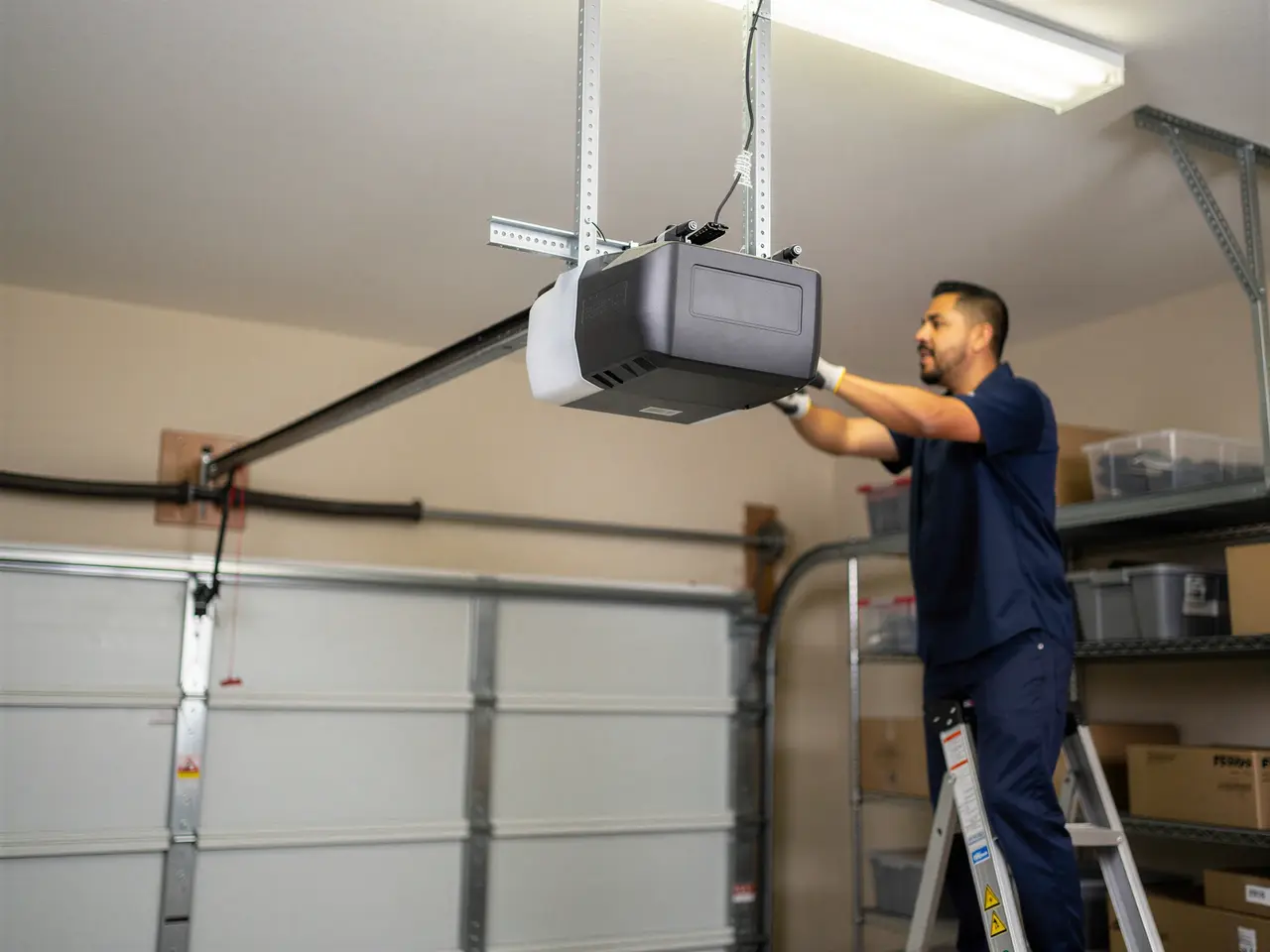
Most opener calls split into two kinds of job: electrical and mechanical. Electrical means the logic board, the wall button, the safety sensors, or the remote - these get tested with a multimeter and swapped individually rather than guessed at. Mechanical means the drive itself: chain, belt, or screw, plus the trolley and carriage that rides it. On a house built around 1969, we're often dealing with hardware from a mid-life replacement rather than the original unit, so the first step on site is figuring out what's actually installed and whether parts for it still exist. If the logic board is dead and the unit is more than about fifteen years old, we'll usually tell you straight that a new opener costs less than hunting down an obsolete board. That's not an upsell - it's the honest math on a part that may not be available at all.
What Is on the Truck
For a town like Eldridge, where the opener population skews toward replacements rather than originals, the truck carries the parts that cover the widest range of brands and ages: universal logic boards, standard remotes and keypads that can be programmed on site, replacement safety sensor pairs, drive chain and belt sections, and trolley and carriage assemblies in the common sizes. What doesn't always come standard is a board for a long-discontinued model - those sometimes need to be ordered, which can mean a short wait rather than a same-visit fix. We'd rather tell you that up front than pretend every job wraps in one trip.
Doing It Yourself
Some opener trouble is worth checking yourself before anyone drives out. If the door won't respond at all, check that the unit is plugged in and the outlet has power - a tripped GFCI near the garage is a common, boring cause. If the door reverses before it closes, the safety sensors near the floor are probably misaligned or dirty; a quick wipe and realignment fixes a surprising number of these calls. If the remote stopped working but the wall button still runs the door, it's almost always a battery or a lost program code, not a failed motor. What you shouldn't do yourself: open the motor housing, mess with the travel limit screws without knowing the sequence for your model, or work on anything connected to a broken spring - that part of the job needs a tech regardless of the opener issue.
The Complications
A few things make opener jobs in this area trickier than they look. Houses built in the late 1960s often have garages framed to dimensions that don't match current standard door sizes, which can mean the opener's travel and force settings need more careful tuning than a newer, code-built garage. Household income in the wider service area runs higher than the median for the state, and in Eldridge itself median income sits around $111,983 - which doesn't change the mechanics of the repair, but it does mean more owners here ask us to replace rather than patch an opener nearing the end of its life, since the cost difference matters less. The honest limitation: if your opener model is old enough that the manufacturer no longer makes the board, we may need to order a part or recommend replacement instead of repair, and that's not something we can diagnose accurately over the phone.
Frequently asked questions
Do you have a branch in Eldridge?
No. We're based in Sonoma, about four miles away, and cover Eldridge from there. There's no local depot, just a tech and a stocked truck making the short drive out.
My opener is original to the house - is that unusual here?
It would be unusual anywhere by now. The median home in this area was built around 1969, so any opener from that era has long since been replaced, often more than once. What we usually find is a mid-life replacement unit, not the original.
Is it worth fixing an old opener or should I replace it?
Depends what's failed. A dead sensor or remote is a cheap, quick fix on almost any unit. A dead logic board on a model old enough that parts are discontinued usually costs more to source than a new opener costs outright - we'll tell you which situation you're in before we start billing time.
Does the climate here cause opener problems?
Not in the dramatic way heat or deep freeze does elsewhere. The area's climate is mild with occasional freezing mornings, which mainly shows up as damp-swollen door jambs throwing off travel limits on older units, more a seasonal adjustment than a failure.
More garage door services in Eldridge
Book garage door service in Sonoma
Call now or request a quote - tell us what the door is doing and where you are.